
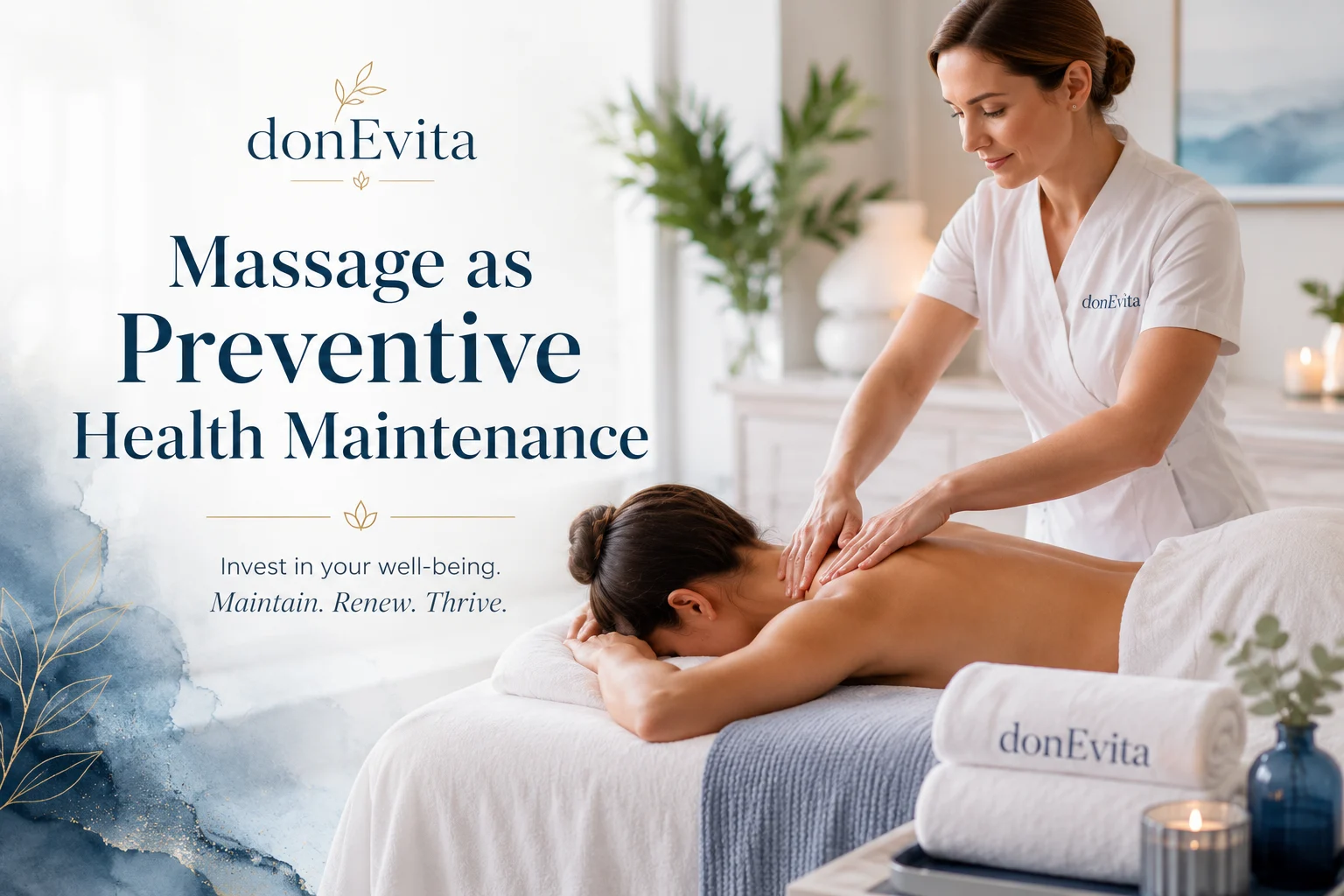
Most people think about massage only when something already hurts. A tight neck. A sore lower back. A shoulder that will not relax. A tired body after too many long workdays, workouts, errands, family responsibilities, and not enough sleep. By the time many people schedule a massage, the body has already been asking for help for weeks, sometimes months.
But massage does not have to be only a rescue plan.
At donEvita, we see massage as part of preventive health maintenance: a regular ritual that helps the body stay softer, calmer, more mobile, and more connected before discomfort becomes a bigger problem. Just like people maintain their car before the engine fails, clean their home before it becomes overwhelming, or visit the dentist before there is pain, the body also benefits from regular care.
Massage is not a replacement for medical care, physical therapy, exercise, sleep, hydration, or a healthy lifestyle. But when used consistently, it can become one of the most supportive habits for everyday well-being. It gives the body a chance to reset, the nervous system a chance to settle, and the muscles a chance to release the tension they have been carrying quietly.
The Body Stores More Than We Realize
Daily stress does not always show up as emotion first. Very often, it shows up in the body.
A person may feel tightness between the shoulder blades after long hours at a desk. The jaw may clench during a stressful season. The lower back may feel heavy from standing, driving, lifting, or sitting too long. The hips may become stiff. The neck may lose its easy range of motion. Even breathing can become shallow when the body is constantly bracing.
Over time, these small restrictions can become the body’s “normal.” Many people do not notice how tense they are until someone places skilled hands on the tissue and the body suddenly realizes, “I have been holding this for a long time.”
Massage helps bring awareness back to these areas. A good massage therapist does not simply push hard. They listen through the hands. They notice where the tissue feels guarded, where the breath changes, where the body softens, and where it resists. This kind of intentional work can help release tension before it develops into a stronger pattern of pain or limitation.
The National Center for Complementary and Integrative Health notes that massage therapy has been studied for several types of pain and stress-related concerns, although the strength of evidence varies depending on the condition and study quality. That is important: massage should be respected as supportive care, not oversold as a cure.
Preventive Care Is About Rhythm, Not Emergency
Preventive maintenance works best when it has a rhythm.
One massage every six months may feel wonderful, but the body often benefits more from consistent care. For some people, that may mean every two weeks. For others, once a month may be enough. The right rhythm depends on lifestyle, stress level, work demands, posture, activity, age, and how quickly the body tends to tighten again.
Someone who works at a computer all day may need regular neck, shoulder, arm, and back work. A person who stands all day may need more attention to the legs, hips, feet, and lower back. Someone who exercises often may use massage to support recovery between workouts. A busy parent or business owner may need massage less for one specific muscle and more for the nervous system as a whole.
At donEvita, this is why we think of our services as rituals rather than quick appointments. A ritual has intention. It is not rushed. It is not random. It gives the body a familiar place to return, release, and rebuild balance.
Massage and the Nervous System
One of the most overlooked benefits of massage is how it can affect the nervous system.
When the body is under constant pressure, it often lives in a state of alertness. Muscles tighten. Breathing becomes shallow. Sleep becomes lighter. Digestion may feel different. The mind may stay busy even when the day is over. Many people describe this as being “wired but tired.”
Massage can help shift the body toward a calmer state. Gentle, steady, intentional touch can signal safety to the nervous system. When the body feels safe, it often softens more naturally. This is why deeper work does not always require force. Sometimes the therapist must first calm the body before the body allows deeper pressure.
Research and clinical summaries commonly describe massage as being associated with relaxation, reduced muscle tension, and stress relief. Mayo Clinic Health System lists potential physical benefits such as decreased muscle stiffness, improved flexibility, less soreness, and better sleep quality, along with mental benefits related to stress reduction.
This does not mean massage magically removes stress from life. The emails, bills, family responsibilities, and work deadlines may still be there. But massage can give the body a break from constantly carrying them.
Why Waiting Until Pain Appears Can Be Costly
Pain is often the last signal, not the first.
Before pain appears, there may already be stiffness, fatigue, reduced motion, poor posture, shallow breathing, or small areas of tenderness. The body may compensate quietly. One tight hip may change how someone walks. One stiff shoulder may make the neck work harder. A tense lower back may affect sleep, which then affects energy, mood, and focus the next day.
Preventive massage helps address these early signs. The goal is not to chase pain after it grows louder. The goal is to notice the patterns early and help the body stay more balanced.
A regular massage may help someone realize, “My right shoulder always tightens when work gets stressful,” or “My hips feel better when I stretch after sitting,” or “My headaches seem worse when my neck and jaw are tight.” This awareness is valuable because it helps people take better care of themselves between visits.
Massage, Movement, and Mobility
Healthy movement is not only about strength. It is also about freedom.
Muscles and connective tissue need movement, circulation, and recovery. When tissue becomes tight or restricted, movement can feel smaller. A person may not turn the head as easily when driving. They may avoid stretching because it feels uncomfortable. They may feel older than they are simply because the body is not moving with ease.
Massage can support mobility by helping reduce muscle tension and encouraging better tissue glide. When muscles feel less guarded, stretching and movement often become easier. This is why many people feel lighter after a massage, as if their body has more space.
Still, massage works best when paired with simple home care. Gentle stretching, walking, hydration, better posture habits, and intentional breathing can extend the benefits. Massage opens the door, but daily habits help keep it open.
The donEvita Approach: Preventive, Personal, and Intentional
At donEvita, massage is not treated as a one-size-fits-all service. Every body arrives with a different story.
Some guests need a calming EvitaFlow™ massage with slow, nervous-system-focused work. Others need firmer attention to areas that have been overused or neglected. Some need only a few moments of deeper pressure in the right place, not an entire session of aggressive work. A skilled therapist understands that pressure is not about proving strength. It is about timing, listening, and adapting.
Our Signature Evita Rituals are built around time, presence, and flow. A 60-minute ritual may be perfect for regular maintenance. A 90-minute ritual allows more detailed work and deeper relaxation. A 120- or 150-minute ritual gives the body enough time to move through multiple layers of renewal, especially when combined with enhancements such as steam sauna, body exfoliation, or head spa.
The steam sauna can help prepare the body by encouraging warmth and relaxation. Body exfoliation refreshes the skin and supports the feeling of renewal. Head spa work can calm the mind and soften the tension many people carry in the scalp, jaw, neck, and upper shoulders. Together, these rituals support the whole person, not just one tight muscle.
Massage as a Wellness Investment
Preventive massage is not only about avoiding pain. It is about protecting quality of life.
When the body feels better, people often move better. They sleep more comfortably. They may feel more patient, more grounded, and more present. They may recover more easily from work, travel, workouts, or long periods of stress.
The American Massage Therapy Association’s consumer research has found that many people view massage as beneficial for overall health and wellness, and many use it for pain relief. While consumer beliefs are not the same as medical proof, they do reflect something important: people often return to massage because they feel a meaningful difference in their bodies.
A preventive approach changes the question from, “How bad does it have to get before I book?” to “How can I support my body before it gets bad?”
That shift matters.
How Often Should Someone Get a Massage?
There is no perfect answer for everyone, but there are helpful starting points.
For general wellness, many people do well with massage once every three to four weeks. For people with high stress, physically demanding work, frequent workouts, chronic tightness, or posture-related discomfort, every two weeks may be more supportive. During especially stressful seasons, a weekly rhythm for a short period may help the body settle and reset.
At donEvita, our VIP rhythm supports this idea of consistency. Guests who return every two weeks receive 15% off, and guests who return within four weeks receive 10% off when booking online. This is designed to encourage care as a rhythm, not as an emergency.
Preventive maintenance does not need to be complicated. It simply needs to be consistent.
When Massage Should Wait
Massage is generally safe for many people, but there are times when it is best to wait or speak with a healthcare provider first. Guests should avoid massage or ask their doctor before booking if they have certain medical concerns such as fever, active infection, unexplained swelling, recent injury, blood clot concerns, uncontrolled high blood pressure, certain skin conditions, or other serious health issues.
Pregnant guests should choose prenatal massage and share any pregnancy-related concerns before the session. At donEvita, Prenatal EvitaFlow™ is approached with gentle positioning and careful pressure, but guests with high-risk pregnancy or medical restrictions should check with their healthcare provider first.
Massage should never feel like something the body has to endure. Good bodywork respects the guest’s comfort, pressure preference, and safety at all times.
A Better Way to Listen to the Body
The body is always communicating. The problem is that most people are too busy to hear it.
Massage creates a quiet space where the body can finally speak. It may reveal where stress is stored, where movement has become limited, and where the nervous system has been working too hard. It may also remind a person that rest is not laziness. Recovery is not a luxury. Care is not something to save only for special occasions.
At donEvita, we believe preventive wellness should feel beautiful, personal, and deeply human. Massage is one of the simplest ways to return to the body before the body has to shout.
A regular ritual can help you stay ahead of tension, support easier movement, calm the nervous system, and make space for better rest. Not because massage fixes everything, but because the body does better when it is cared for consistently.
Massage as preventive health maintenance is not about waiting until you break down.
It is about choosing renewal before you need repair.