
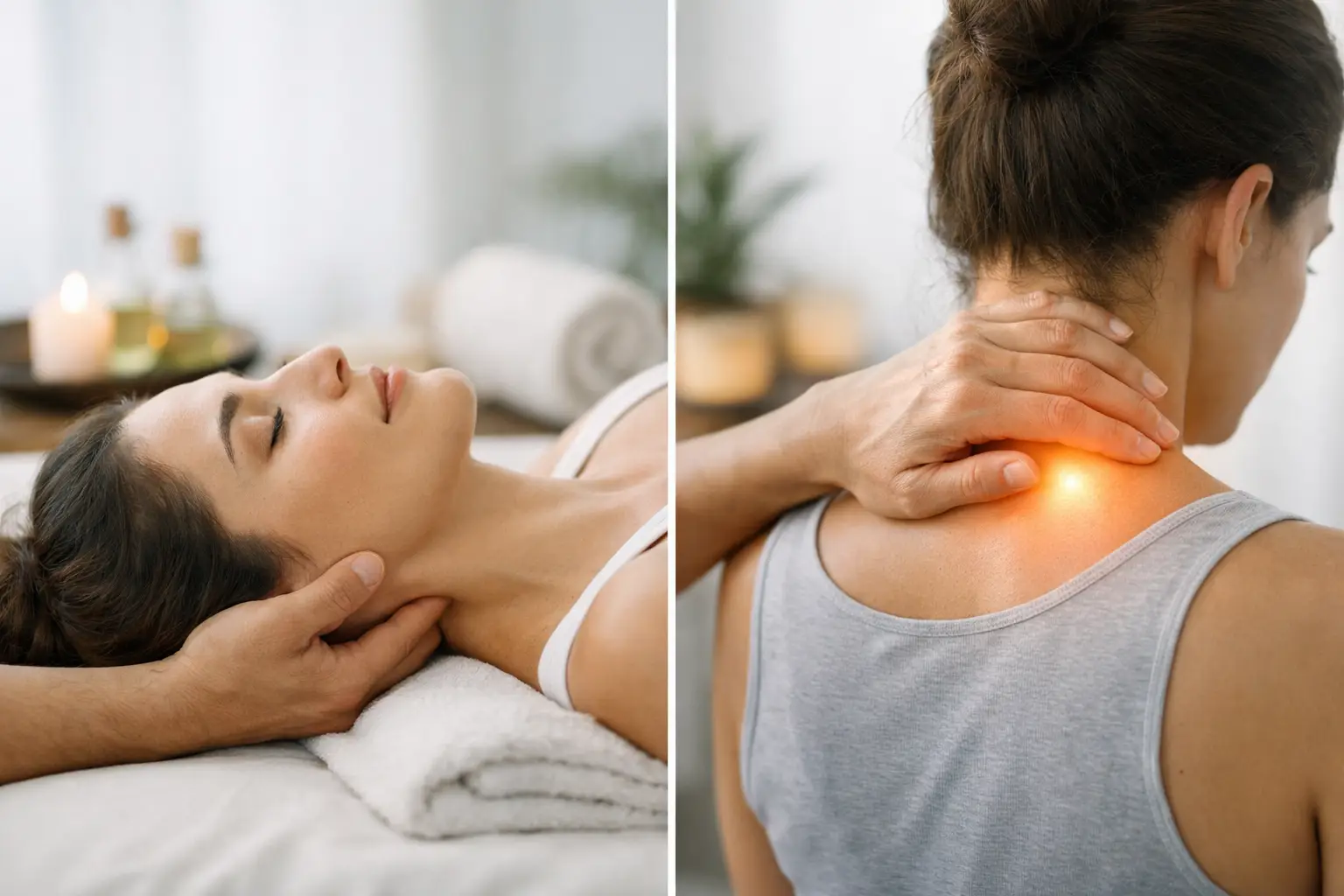
Neck and upper-back tension does not always begin where it hurts. For some people, the front of the chest feels shortened or guarded, the shoulders sit forward, and the muscles around the neck and shoulder blades work harder during driving, desk work, lifting, or phone use.
A common description is, ‘My pecs feel tight all the way under my breasts.’ That may be muscular, but location alone cannot confirm the source. The pectoralis major covers much of the front chest, while the deeper pectoralis minor connects the upper ribs to the shoulder blade. The serratus anterior wraps around the side ribs, and the intercostal muscles sit between the ribs. Breast tissue, ribs, nerves, skin, and internal organs can also produce symptoms in this region.
If the feeling is mild, changes with posture or arm movement, and resembles a familiar muscle stretch, a gentle mobility-and-strength routine may be reasonable. Pain or pressure in the chest or breast, however, deserves a more careful safety check before anyone assumes the pecs are simply tight.
Why Tight Pecs May Affect the Neck and Upper Back
The pectoralis major moves the arm across the body and assists with pushing and inward rotation. The pectoralis minor helps position the shoulder blade. When the front of the chest is stiff and the shoulders rest forward, the muscles around the shoulder blades and neck may have to work differently to support the arms and head.
This does not mean there is one perfect posture or that rounded shoulders automatically cause pain. Posture is only one piece of a larger picture that can include workload, sleep, stress, activity level, injury, breathing pattern, and individual anatomy. It also means stretching is not always the whole answer.
Research in people with rounded-shoulder patterns suggests that pectoralis stretching can change muscle length or shoulder position in some groups. Small trials also suggest that adding lower-trapezius or scapular-retraction strengthening may be more useful than stretching alone for postural measures. Results should be interpreted modestly: several studies involved small samples of young or otherwise specific populations, and improved posture does not guarantee pain relief.
First, Make Sure It Is Appropriate to Exercise
Do not stretch through pain in the breast itself. New or unexplained discomfort beneath one breast, a lump, swelling, skin dimpling or redness, nipple changes or discharge, or a persistent change in the breast should be discussed with a healthcare professional. Most breast changes are not cancer, but they still deserve evaluation rather than forceful massage or stretching.
Call 911 for possible heart-attack symptoms, including new chest pressure, squeezing, fullness, or pain—especially with shortness of breath, sweating, nausea, lightheadedness, unusual fatigue, or discomfort in the arm, shoulder, back, neck, jaw, or upper abdomen. Women can have symptoms that are subtler than expected.
Stop the routine and seek professional guidance for sharp or worsening pain, numbness, tingling, weakness, dizziness, pain traveling down an arm, symptoms after an injury, fever, pain with breathing, or symptoms that do not begin to settle. Recent breast or chest surgery, radiation, shoulder instability, osteoporosis, or a known heart, lung, neurologic, or musculoskeletal condition also calls for individualized clearance.
A Gentle, Research-Informed Exercise Routine
The goal is not to force the chest open. It is to restore comfortable movement, help the shoulder blades share the workload, and notice how the body responds. Start with easy effort. A stretch should feel like mild-to-moderate tension in muscle—not pinching in the shoulder, pulling in breast tissue, burning, numbness, or pain.
1. Lateral Rib and Diaphragmatic Breathing
Lie on your back with the knees bent or sit supported. Place the hands around the lower side ribs. Breathe in slowly through the nose and allow the lower ribs to expand sideways and gently into the back. Exhale without forcing the ribs down.
Take 5 slow breaths, rest, and repeat once. Keep the shoulders quiet instead of lifting them toward the ears. This is a low-load way to explore rib movement and reduce breath-holding; it is not a test or a treatment for unexplained pain beneath the breast.
2. One-Arm Doorway Pec Stretch
Place one forearm on a door frame with the elbow at or a little below shoulder height. Step forward or turn the chest away a few degrees until a comfortable stretch is felt across the front of the chest. Keep the shoulder away from the ear, the neck relaxed, and the ribs stacked rather than flared forward.
Hold for 20 to 30 seconds. Repeat 2 times per side. A one-arm self-stretch is a sensible starting choice because it allows each side and the intensity to be controlled independently.
3. Lower-Angle Doorway Stretch
If the shoulder-height position is uncomfortable, place the hand or forearm somewhat lower on the frame and gently rotate away. The changed arm angle may move the sensation lower across the chest or make the stretch easier to tolerate.
Hold for 20 to 30 seconds and repeat 2 times per side. Feeling a stretch beneath the breast does not prove that a specific ‘lower pec’ fiber is the source, so do not chase the exact sensation or press into breast tissue.
4. Thoracic Extension Over a Chair or Rolled Towel
Sit in a firm chair with the hands supporting the head, or lie with a rolled towel placed across the mid-to-upper back—not the neck or lower back. Gently extend the upper back over the support while keeping the movement comfortable and the lower ribs from thrusting upward. Return slowly.
Perform 6 to 8 easy repetitions. Thoracic-extension exercise paired with scapular stabilization has improved posture, pain, and disability measures in a small randomized trial of office workers with forward-head posture, but this is not suitable for everyone with spinal pain or osteoporosis.
5. Scapular Setting
Sit or stand tall without forcing the chest upward. Gently guide the shoulder blades slightly back and down, as though placing them into back pockets. Avoid squeezing hard, shrugging, or holding the breath.
Hold for 3 to 5 seconds. Repeat 8 to 12 times. The movement should be small; the goal is control, not maximum contraction.
6. Resistance-Band Rows
Anchor a light resistance band securely at about lower-chest height. Hold one end in each hand. Begin with the arms forward, then draw the elbows back while keeping the shoulders away from the ears. Pause when the shoulder blades move gently toward each other, then return with control.
Perform 2 sets of 10 to 15 repetitions, resting between sets. Stop before form becomes strained. Scapular-retraction strengthening is an important counterpart to chest stretching, and one small comparative study improved forward-shoulder posture more with retraction exercise than with pectoralis stretching alone.
7. Wall Slides or Comfortable Wall Angels
Stand with the back near a wall and the feet slightly forward. Place the forearms against the wall if comfortable. Slowly slide the arms upward only as far as the shoulders can move without pinching, rib flare, or shrugging, then return.
Perform 8 to 12 repetitions. The hands and elbows do not have to remain pressed flat. A pain-free range is more useful than forcing the classic ‘angel’ shape.
8. Gentle Chin Tucks
Keep the eyes level and draw the head straight back a small amount, as though making a slight double chin. Do not look down or press hard.
Hold for 3 to 5 seconds. Repeat 5 to 10 times. Stop if this produces headache, dizziness, arm symptoms, or increasing neck pain.
A Simple 5–10 Minute Plan
- Take 5 slow lateral-rib breaths.
- Choose one doorway stretch and hold 20–30 seconds twice on each side.
- Perform 6–8 thoracic extensions.
- Perform 8–12 wall slides or scapular-setting repetitions.
- Perform 2 sets of 10–15 light band rows on two or three nonconsecutive days each week.
General flexibility guidance from the American College of Sports Medicine uses a stretch of about 10–30 seconds, repeated 2–4 times, on at least 2–3 days each week. Daily gentle stretching may be comfortable for some people, but more intensity is not automatically better. Begin with the smaller dose above and judge the response later that day and the next morning.
If symptoms consistently worsen, the location changes, or there is no improvement after a couple of weeks, stop guessing and ask a physical therapist or other qualified healthcare professional for an assessment. An individualized plan may differ substantially from this general routine.
Where Massage May Fit
Wellness massage may help a guest relax and become more aware of tension in the chest, shoulders, neck, and upper back, but it does not diagnose the cause of pain. A massage therapist can ask about symptoms, pressure preferences, movement, positioning, and medical history within their scope, then determine whether massage is appropriate or a referral is safer.
Any hands-on work near the pectoral region requires clear informed consent, professional draping, respect for boundaries, and compliance with Texas massage rules. Breast tissue should not be treated as though it were a tight muscle. Work around the chest, ribs, underarm, or surgical areas may also be inappropriate without specific training or medical clearance.
At donÉvita, guests can request a personalized EvitaFlow™ massage focused on comfort and relaxation. Exercise instruction, injury rehabilitation, and diagnosis belong with an appropriately qualified healthcare professional.
The Bottom Line
For mild, clearly movement-related pectoral tightness, the most balanced approach is usually not an aggressive chest stretch. Start with comfortable rib breathing and one-arm doorway stretching, then add thoracic movement and gradual strengthening for the shoulder-blade muscles. The combination is more consistent with the available research than stretching the pecs alone.
Tightness that runs beneath a breast should still be treated as a description, not a diagnosis. If the sensation is painful, new, one-sided, persistent, unrelated to movement, or accompanied by chest or breast warning signs, seek medical evaluation before massage or corrective exercise.
Sources and Further Reading
- Journal of Orthopaedic & Sports Physical Therapy: Neck Pain Clinical Practice Guidelines
- Randomized comparative study of pectoralis-minor stretching with lower-trapezius strengthening
- Comparison of pectoralis stretching and scapular-retraction strengthening
- Randomized trial: pectoralis-minor stretching added to a shoulder exercise program
- Randomized trial of scapular stabilization and thoracic-extension exercise
- American College of Sports Medicine: General flexibility and resistance-training dosage
- American Heart Association: Heart-attack symptoms in women
- National Cancer Institute: Breast changes that should be evaluated