
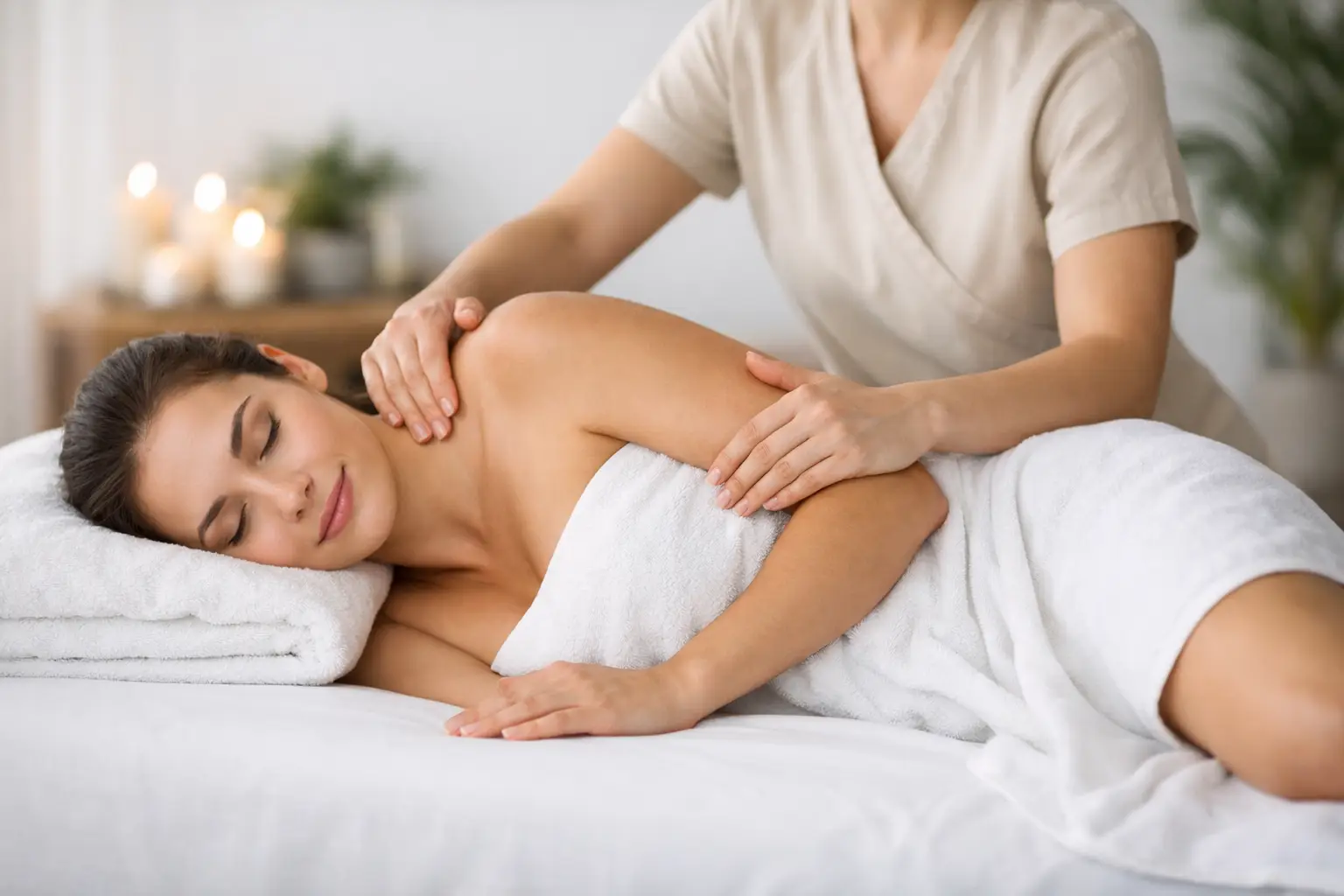
There are moments when lying face down asks too much of the body. The neck tightens. The low back protests. Breath feels shallow instead of easy. Side laying massage answers that moment with a quieter kind of support - one that follows the body's natural need for softness, stability, and room to rest.
Rather than placing the body in a fully prone or face-up position, this approach invites you to recline on your side with cushions and bolsters arranged around you. The effect is immediate. Joints are less compressed, the chest can expand more freely, and the nervous system often settles faster because the body does not need to brace against discomfort. For many people, that change in position is not a small adjustment. It changes the entire feel of the ritual.
Why side laying massage feels different
A traditional massage position can be deeply effective, but it is not ideal for every body on every day. Side laying massage creates a sense of containment. The body feels held rather than arranged. With support between the knees, under the head, and sometimes along the back or abdomen, tension can begin to release before the first stroke even begins.
This is one reason the technique is often chosen for guests who want more ease through the hips, shoulders, and lower back. It can also be a thoughtful option during pregnancy, for anyone who finds face-down positioning uncomfortable, or for those who simply feel more at peace on their side. Comfort matters here, not as an afterthought, but as part of the therapeutic experience itself.
There's also a subtle emotional quality to this posture. Side-lying can feel more private, more protected, and more grounded. For some, that sense of safety allows deeper relaxation than a standard table setup ever could.
Who benefits from side laying massage
This ritual tends to suit people who need adaptability without sacrificing depth. If the body is tender, easily fatigued, or sensitive to pressure in the front of the hips, chest, or abdomen, side-lying often creates a gentler starting point. It can be especially supportive when turning the head to one side causes strain, or when prolonged time on the back leaves the body restless.
That said, it is not only for people with a specific need. Some guests simply prefer it. They like the slower exhale it invites. They like the sense of being cradled. They like that the session feels less performative and more intuitive.
As with any bodywork approach, it depends on the person, the intention, and the skill of the therapist. Certain techniques are easier to perform in other positions, and some sessions may move between side-lying, face-up, and face-down work. The most helpful experience is rarely about forcing one format from beginning to end. It's about choosing what serves the body best in that moment.
What happens during a side laying massage
The setup is more intentional than many people expect. Pillows and bolsters are placed with care to keep the spine neutral and the hips supported. The top arm and leg may be cushioned so the shoulders can soften and the pelvis can rest without twisting. Once the body is settled, the work can focus on areas that often hold layered tension: the side body, glutes, outer hip, lower back, shoulders, and neck.
This position gives the therapist access to muscles that are sometimes overlooked in more standard routines. The lateral line of the body - from rib cage to hip to outer thigh - can be worked with a beautiful sense of continuity. For guests who carry stress in the waist, the upper glutes, or the area around the shoulder blade, this can feel especially relieving.
Pressure can still be firm when appropriate, but the overall feeling is usually less forceful and more attuned. The body is not fighting gravity in the same way. It can receive.
Side laying massage and pregnancy
One of the most recognized uses of side laying massage is during pregnancy, when comfort and circulation become even more essential. In later stages, lying face down is no longer practical, and lying flat on the back may not feel good for long. Side-lying offers a balanced alternative that supports the changing body with more kindness.
But care matters. Positioning should be precise, pressure should be thoughtful, and the session should be shaped around the guest rather than around a fixed sequence. That's where premium care reveals itself - not in excess, but in attention.
A more intuitive kind of rest
Here at donÉvita, wellness is never reduced to technique alone. The position of the body, the pace of the room, the quality of touch, and the feeling of being deeply considered all belong to the same experience. Side laying massage fits naturally within that philosophy because it begins with listening.
Sometimes the most restorative choice is not the most familiar one. It's the one that lets the body unclench, the breath lengthen, and stillness arrive without effort. If that is what your body has been asking for, side-lying may feel less like an alternative and more like coming home to ease.