
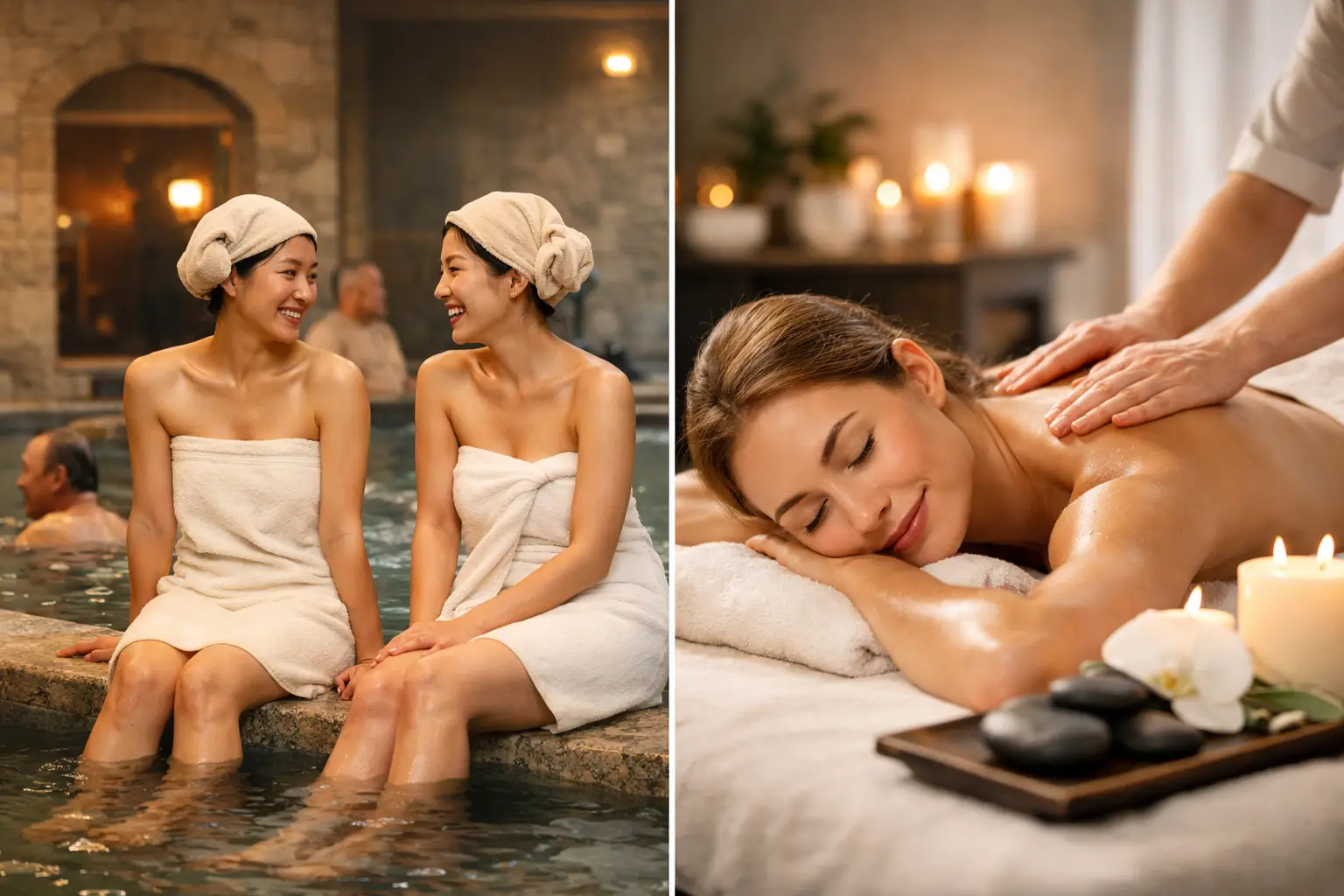
Some spa visits begin with a treatment menu. Others begin with a change of pace.
That is often the real question behind korean spa vs day spa. It is not only about services. It is about how you want to feel when you walk in, how much time you want to spend, how private you want the experience to be, and whether restoration looks like quiet ritual or a more communal rhythm.
Both can be deeply calming. Both can leave the body softer, the mind quieter, and the breath a little steadier. But they create that feeling in very different ways.
Korean spa vs day spa: the core difference
A Korean spa, often called a jjimjilbang, is usually built around shared wellness spaces and heat-based rituals. Guests may move through saunas, warm rooms, cold plunges, soaking areas, and lounge spaces over several hours. The experience is often unhurried and layered, with hydrotherapy, contrast temperatures, and body exfoliation playing a central role.
A day spa is typically more treatment-centered and private. You book a service or a series of services, arrive at a scheduled time, and settle into a curated experience that may include massage, facials, body scrubs, scalp treatments, or soaking rituals depending on the spa. The structure is usually more personalized, more contained, and easier to shape around a busy week.
Neither is better in every situation. They simply answer different needs.
What a Korean spa experience usually feels like
A Korean spa often has a social, immersive energy. Even in very peaceful spaces, there is usually a sense of flow - people moving from heat to water to rest, staying for hours, sometimes sharing food or conversation between rituals. For guests who enjoy spending a long stretch of time unwinding without watching the clock, that can feel freeing.
Heat is often the language of the experience. Dry saunas, steam rooms, clay rooms, salt rooms, soaking pools, and cold exposure may all be part of the visit. The body is asked to soften gradually. Muscles loosen. Skin warms. The nervous system often shifts because the pace itself changes.
One of the most distinctive offerings is the Korean body scrub. This treatment is known for vigorous exfoliation that removes dull, rough skin in a very visible way. Some people love that feeling of being thoroughly polished. Others find it more intense than the softer, more aromatic body rituals offered in many traditional spas.
Privacy can be the biggest point of difference. Korean spas frequently include communal areas, and certain wet areas may have nudity requirements depending on the facility. For some guests, that feels completely natural once they settle in. For others, it creates hesitation that can make relaxation harder to reach.
What a day spa experience usually feels like
A day spa tends to feel quieter, more sheltered, and more intentionally guided from beginning to end. Instead of moving through a large circuit on your own, you are often led into a treatment room where the environment is shaped around your comfort - dim light, soft music, warm linens, calming scent, and a therapist or esthetician focused on your needs.
That difference matters if your life already feels overstimulated. Many guests are not looking for more activity, even restorative activity. They want the nervous system to stop bracing. They want a place where the details have already been considered.
A day spa also offers more room for customization. If your shoulders carry stress, your skin feels dry, your scalp needs care, or you want a couples escape rather than a communal setting, the experience can usually be tailored in a more personal way. Organic oils, botanical scrubs, steam, hot towels, and targeted enhancements can turn a standard appointment into something that feels restorative rather than routine.
The best day spas understand that touch alone is not the whole story. Water, warmth, exfoliation, scent, stillness, and skilled pacing all shape the experience. That is often what guests mean when they say a service felt like a ritual rather than just a treatment.
Choosing based on privacy, pace, and purpose
If you are deciding between a Korean spa and a day spa, start with your comfort level rather than the menu.
If you enjoy communal wellness spaces, like spending several hours exploring heat and hydrotherapy, and do not mind a less private environment, a Korean spa may feel expansive and refreshing. It can be especially appealing if you want a full day away from your normal routine and like the idea of creating your own rhythm.
If you prefer privacy, one-on-one care, and an experience designed around your body and mood, a day spa may feel more natural. It often suits people who want to arrive, exhale, and be taken care of without having to navigate shared spaces or build the experience themselves.
Purpose matters too. For social relaxation, all-day lingering, and traditional scrub culture, a Korean spa has its own appeal. For personalized bodywork, skin nourishment, a peaceful couples visit, or a quiet reset after a demanding week, a day spa often meets the moment more gently.
Korean spa vs day spa for first-time guests
For first-time spa guests, korean spa vs day spa often comes down to one thing: ease.
A Korean spa can be wonderful, but it may come with more unknowns. There may be different zones, cultural etiquette, communal areas, and longer visits to plan around. If that sounds interesting, it can be a memorable introduction to a new kind of wellness ritual. If it sounds like one more thing to figure out, it may not be the most relaxing place to start.
A day spa is usually easier to enter with confidence. You book what you want, arrive, and let the experience unfold with support. That simplicity can make a real difference, especially if your body is already tense or your mind is full.
There is also a sensory difference. Korean spas often feel broad and varied. Day spas usually feel more contained and intentional. One gives you a landscape to move through. The other gives you a room to settle into.
When a day spa may be the better fit
A day spa tends to be the stronger choice when you want care that feels personal rather than generalized. If your skin is craving softness, your muscles need focused attention, or your mind feels worn thin, the value is not just the service itself. It is the way the service is shaped around you.
That is where a premium wellness setting can feel especially meaningful. In a sanctuary such as donEvita, the experience is not built like a checklist of appointments. It is approached as renewal - guided through therapeutic touch, warm steam, nourishing exfoliation, organic oils, and a peaceful rhythm that helps the body let go. For many guests, that kind of intentional quiet is what they were seeking all along.
This does not mean a day spa is always the answer. If you love communal bath culture and want to stretch your visit across an afternoon, a Korean spa may suit you beautifully. But if your idea of restoration is privacy, softness, and customized care, a day spa often feels closer to the heart of what you need.
The trade-off most people do not consider
People often compare these two experiences by looking at amenities. Pools, saunas, massages, scrubs. But the more important trade-off is emotional.
A Korean spa can feel energizing in its own way, even while it relaxes you. There is movement, variety, and often a subtle awareness of other people around you. A day spa usually feels more inward. The energy narrows. The world quiets. You are not simply passing time there. You are recovering something.
That is why the right choice depends on the season you are in. Sometimes you want an all-day wellness outing. Sometimes you want to be wrapped in warmth and left with enough stillness to hear yourself think again.
If you are torn between the two, ask a simpler question than korean spa vs day spa. Ask what kind of exhale you need right now. The answer is usually there, waiting beneath the noise.